
When Worlds Collide
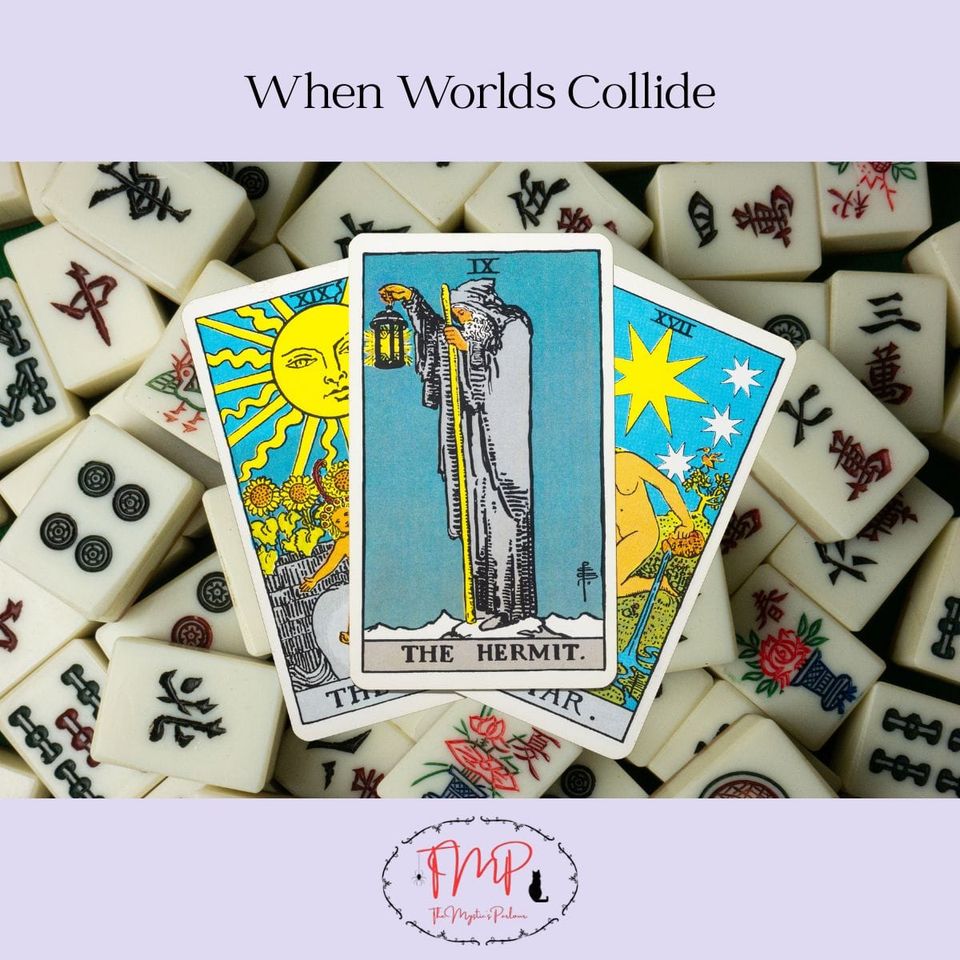
Last week I wrote about the life lessons that apply to the game of mahjong, and vice-versa. This week I’m talking specifically about the ways in which mahjong and tarot have intersected (more so than collided) in my world. These sorts of intersections happen more often than we realize, and I try to pay attention when they do.
As you may know, I’ve read tarot in some form for most of my adult like (with a brief sabbatical). I only recently began playing mahjong but the similarities between the people I know who engage in one or the other (often times both) became instantly clear.
The visual aesthetics are at the forefront. Presented as small, self-contained works of art, tarot cards are paintings, mahjong tiles are jewels. Both are pleasing to look at and make us feel connected to the medium.
The audio aesthetic is equally mesmerizing. Both the sound of shuffling cards and clicking tiles alert our brains to focus on what’s about to happen.
We like to touch things. Tarot cards are shuffled, arranged in a spread, then picked up multiple times throughout the course of a reading. Mahjong tiles are also shuffled, washed (by pushing them around on the table until mixed up, then arranged neatly in walls in preparation for the play. Each tile is then drawn from the wall, either racked and grouped with the hand, or discarded in a growing collection in the center of the table.
We can’t leave well-enough alone. Some mahjong players modify their tiles by enhancing them with paint or nail polish. Tarot card collectors sometimes trim borders off decks, often edging them with markers or paint pens.
There are classic tarot decks (RWS, Thoth, Marseille), artist inspired interpretations of these decks, and also boutique versions where the suits and symbolism is a bit of a stretch. The same can be said for mahjong sets. It’s not unusual to hear “what is this?” in an open group setting where players bring their own tiles.
The same can be said for the standard blueprint for mahjong, which is the National Mahjong League annual card, published every April for almost 100 years. Alternates have come on the scene, with the same goal of following fixed hands for the year but expanding the options with math categories and different combinations (Hong Kong and other types of mahjong don’t use an annual card, instead there are fixed, scorable hands).
All these variations aside, when sitting across the table, focusing on the common element, we find a sense of connection without sacrificing our individual inclinations. What we see in the cards reflects who we are, as does our approach to playing mahjong. Styles of play are as diverse as the tiles themselves.
There’s a shared sense of liminal time when reading tarot and playing mahjong. The table becomes a vortex as we travel through the experience together, only returning to the present when the reading or the game is ended.
Cards and tiles are dealt in random order but never fail to astound us how they come together in a way that makes sense to our brains as the reading or game progresses. And we all see it, in our own unique way.
We prefer to engage in both tarot and mahjong with each other, but we’re perfectly happy going it alone if that’s the only choice (thanks to the addition of mahjong apps that allow us to play with remote players or game bots).
Tarot readers collect tarot decks (and usually other divination tools). Mahjong players almost always have more than one set of tiles. There are also myriad peripherals. Reading cloths, tile mats. Card holders and tile racks. Coordinated cases for cards and tiles (and their accessories). And the books. So. Many. Books.
Then, there’s the sense of identity. We ARE tarot readers. We ARE mahjong players. We don our collection of T-shirts and other wearable items. Mugs, bags, stickers, notebooks and such are the beacons that help us find each other in the wild. How do you know someone plays mahjong or reads tarot? Oh, you’ll know. We never tire of talking about how this mornings cards blew us away, or how the last tile on the wall was the one we needed to mahjong.
It sounds cheesy and over-the-top (and sometimes is) but if we share our passion for tarot or mahjong (or both) with you, it’s because we like you. It’s an invitation into our world and we wouldn’t welcome you if we didn’t want you around. See you at the table. Don’t be late (see last week’s column).
One piece of advice: if you’re new to tarot or mahjong, try a few different decks/tile sets before deciding where to begin your collection. Because whatever path you choose, there WILL be a collection so start budgeting now.
Now, for the housekeeping segment of our time together:
I host live tarot readings and ramble sessions every Sunday at 10am CDT as part of the Trusted Tarot group on Facebook. You can join in (or just watch) here: Trusted Tarot
I’m offering a free beginner tarot workshop on August 22nd and 23rd designed to help anyone curious about the tarot to start reading their cards right away and encourage them to take their studies deeper. Email me at the address below if you’d like to join us.
And I’m presenting a talk on The Dao of Witchcraft at WitchCon in February 2027.
More events and offerings to follow but you can always reach me via email at themysticsparlour@gmail.com, follow me on Instagram as @the.mystics.parlour, or send me a friend request on Facebook.
If you would like to know more about my ancestral connection work, my Daoist path, or my other offerings such as tarot readings and classes, spiritual guidance, and mindset mentoring, you can find more detailed information by using the drop-down menu on my website: https://the-mystics-parlour.ghost.io
I appreciate your continued support and encouragement. See you sometime next week.